News & Insights · Feature
Why Collectors Still Buy Banksy in 2026
Discover why Banksy remains one of the world’s most sought-after contemporary artists, from strong collector demand and market resilience to cultural relevance and blue chip status.
· By stu@asok.co.uk · 12 min read

Few contemporary artists provoke quite as much discussion as Banksy.
For some collectors, he represents one of the most important artistic voices of the past three decades. For others, he remains an outsider who successfully challenged many of the traditional structures of the art world. Yet regardless of where individual opinions fall, there is one point that is difficult to dispute: Banksy has built one of the most remarkable and resilient contemporary art markets of the 21st century.
More than twenty years after his rise from Bristol’s underground street art scene, demand for his work remains exceptionally strong. His images continue to appear in museums, auction houses, private collections and newspaper headlines around the world. New generations of collectors are entering the market, while established buyers continue to compete for the most desirable works.
At a time when many contemporary artists experience periods of intense popularity before gradually fading from view, Banksy has managed to do something very different. He has remained culturally relevant, commercially successful and widely discussed long after many expected the phenomenon to fade.
The question is no longer whether Banksy belongs in conversations about serious contemporary art - but rather, why collectors continue to buy him.

Banksy Is No Longer Just a Street Artist
There was a time when Banksy was viewed as an outsider to the art establishment.
His early work challenged authority, mocked institutions and appeared in public spaces without permission. Part of the appeal came from the fact that he existed outside the traditional gallery system. Collectors were often buying into an idea as much as an artwork: an artist who appeared to reject many of the conventions that governed the art world.
That narrative still forms part of Banksy’s appeal, but it no longer tells the whole story.
Today, Banksy’s work occupies a very different position within contemporary art. Major museums have exhibited his work. His pieces have entered important private collections. Auction houses dedicate significant attention to his market, while specialist advisors, dealers and collectors now view his work through the same lens as many established blue chip artists.
Perhaps the most impressive aspect of Banksy’s evolution is that he has managed to maintain much of his original cultural relevance while simultaneously becoming one of the most commercially successful artists in the world.
That balancing act is incredibly rare. Many artists who achieve widespread popularity eventually lose the sense of authenticity that attracted collectors in the first place. Banksy has largely avoided that fate. Whether through new installations, political interventions or public projects, he continues to generate discussion beyond the confines of the art market.
For collectors, that matters. Cultural relevance is often one of the strongest indicators of long-term market strength.
A Market That Continues to Defy Expectations
Over the past decade, Banksy’s market has matured significantly.
What was once considered a relatively niche area of collecting has developed into one of the most active sectors of the contemporary art market. Demand now spans private collectors, institutions, family offices and international buyers across multiple continents.
What makes this particularly notable is that confidence has remained strong despite periods of wider uncertainty across both financial and art markets.
In recent months, collector sentiment has been supported by a combination of factors. Public attention surrounding new Banksy projects continues to generate media coverage, while strong auction results have reinforced confidence across both the edition and original work markets.
One notable example came with the sale of a work from Banksy’s celebrated Crude Oils series, which achieved approximately $18 million through Fair Warning’s private auction platform. As one of the highest prices ever achieved for a Banksy work, the result demonstrated that demand at the top end of the market remains extremely robust.
At the same time, activity within the print market has remained healthy, with sought-after editions continuing to attract competition among collectors.
This combination of strength at both the high and entry levels of the market is one of the reasons Banksy’s position remains so compelling.
Many artist markets rely heavily on either trophy works or accessibility. Banksy’s market benefits from both.
Has Banksy’s Identity Reveal Changed Anything In His Market?
For years, Banksy’s anonymity has been treated as one of the most important parts of the story.
The mystery helped shape the mythology. It allowed the work to speak for itself, fuelled endless speculation and turned the artist into one of the most recognisable anonymous figures in the world. As a result, when a Reuters investigation earlier this year claimed to have traced Banksy through court records and historical documents, many wondered whether it might finally puncture some of that mystique.
If the market was going to wobble, that felt like the moment it would happen. Instead, the opposite appears to have happened.
Just months later in May 2026, Girl And Balloon on Found Landscape from Banksy’s celebrated Crude Oils series achieved approximately $18 million through Fair Warning, the members-only auction platform founded by former Christie’s Chairman of Post-War and Contemporary Art, Loïc Gouzer. The result became the third-highest auction price achieved for a Banksy work and reinforced confidence at the very top end of the market.

More interesting than the price itself was what the sale suggested about collector behaviour.
For years, it has been easy to assume that part of Banksy’s appeal lies in not knowing who he is. Yet the reaction from the market suggests that many collectors may have moved beyond that question. Today’s buyers are not acquiring Banksy works because of the mystery alone. They are buying into one of the most influential bodies of work produced by a contemporary artist in the last three decades.
The market has matured considerably since the early days of street art collecting. Collectors now assess Banksy through many of the same lenses applied to other blue chip artists: provenance, rarity, cultural significance, exhibition history and long-term relevance. The artist’s identity may remain a source of fascination, but it no longer appears to be the primary driver of demand.
If anything, recent results suggest the opposite. The market’s response indicates that confidence in the work itself has become far more important than the mythology surrounding the artist.
The Images That Defined a Generation
One of the reasons Banksy’s market has remained resilient is that many of his most famous works have transcended the art world entirely.
Certain images have become part of contemporary culture in a way that very few artworks achieve.

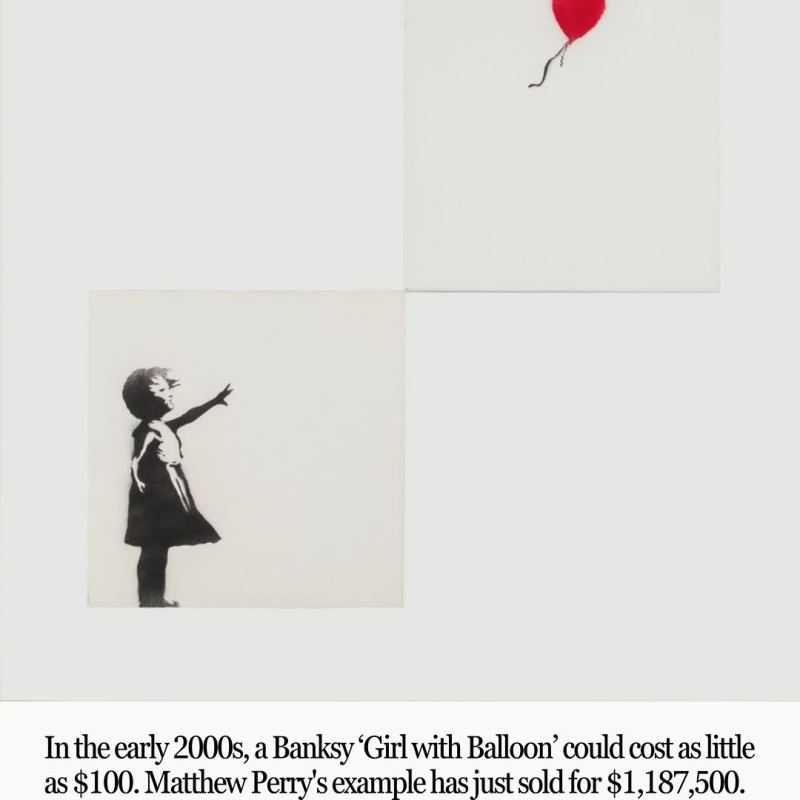
Girl With Balloon
Arguably Banksy’s most recognisable image, Girl With Balloon has become a symbol that extends far beyond contemporary art collecting.
Its themes of hope, loss and optimism continue to resonate globally, while the image’s simplicity has helped it remain instantly recognisable across generations.
The work’s transformation into one of the most famous auction moments in history following the self-shredding incident only reinforced its place within contemporary art history.

Love Is In The Air
Also known as Flower Thrower, this image remains one of Banksy’s most politically charged and enduring works.
The contrast between confrontation and peace has allowed the image to retain relevance across changing political and cultural landscapes.
Collectors continue to view it as one of the defining works within the Banksy catalogue.

Napalm
Perhaps one of Banksy’s most provocative images, Napalm combines familiar pop culture figures with uncomfortable historical references.
The work exemplifies Banksy’s ability to blend humour, criticism and social commentary in ways that remain immediately recognisable.

Crude Oils
The Crude Oils series occupies a particularly important place within the artist’s body of work.
These hand-painted interventions on traditional paintings are significantly rarer than many of Banksy’s editions and have become increasingly sought after by serious collectors. Recent market activity has only strengthened their status within the artist’s wider market.
Why Collectors Continue to Trust the Banksy Market
Collector confidence is rarely built on a single factor.
Instead, it tends to emerge when multiple elements align over a sustained period of time.
Global Recognition
Few contemporary artists enjoy Banksy’s level of international recognition.
His work resonates with collectors in Europe, North America, Asia and the Middle East, creating a broad and diversified collector base that helps support long-term demand.
An Established Secondary Market
Banksy’s market is no longer emerging.
Collectors can analyse decades of auction records, private sales activity and historical pricing data. While no market is completely predictable, this level of transparency provides confidence that newer collectors often find reassuring.
Institutional Acceptance
Although Banksy’s relationship with institutions has sometimes been complex, his work is increasingly discussed alongside artists traditionally viewed as blue chip.
That shift has helped broaden his appeal among collectors who may previously have dismissed street art as a niche category.
Cross-Generational Appeal
Perhaps most importantly, Banksy continues to attract new audiences.
Collectors who discovered his work twenty years ago remain active in the market, while younger buyers continue to enter through editions and lower-value acquisitions. This constant replenishment of demand is a significant strength.
Banksy Prints vs Original Works
One of the defining characteristics of the Banksy market is the strength of its editions.
For many collectors, prints provide the first meaningful entry point into ownership. Unlike some artists whose print markets are viewed as secondary, Banksy’s editions have developed into an important collecting category in their own right.
Signed examples of key images continue to attract strong demand, particularly where rarity, condition and provenance align.
Collectors entering the Banksy market often begin with editions because they offer accessibility without sacrificing cultural significance. Many of the artist’s most recognisable images exist within print form, allowing buyers to acquire works that remain central to Banksy’s artistic legacy.
Original works operate within a very different market.
Scarcity becomes significantly more pronounced, competition increases and values rise accordingly. Major paintings, sculptures and unique works often attract interest from experienced collectors seeking pieces that represent important moments within the artist’s career.
Rather than viewing editions and originals as competing categories, many collectors see them as complementary parts of the same market.
What Collectors Are Looking For in 2026
As the Banksy market continues to mature, buyers have become increasingly sophisticated.
Collectors are paying closer attention to:
provenance and ownership history
Pest Control authentication
condition
rarity
colourway variations
edition size
historical significance
exhibition history
market availability
quality within a particular series
Increasingly, buyers are not simply purchasing a Banksy. They are looking for the right Banksy. That distinction becomes more important as markets mature.
Banksy’s Unconventional Route to Blue Chip Status
Most blue chip artists arrive there through a relatively predictable process. Their careers are built through gallery representation, institutional exhibitions, critical recognition and decades of collector support. Over time, their work becomes embedded within museum collections, academic discussion and the wider history of contemporary art.
Banksy’s trajectory has been anything but conventional.
His reputation was built outside many of the traditional structures that helped establish artists such as Warhol, Hockney or Basquiat. Long before museums and auction houses embraced his work, Banksy had already captured public attention through interventions on walls, buildings and public spaces, creating images that travelled far beyond the art world and into mainstream culture.
For years, this outsider status led some collectors and critics to question whether Banksy would ultimately achieve the same level of market maturity as more traditionally established contemporary artists. Looking at the market today, that debate feels largely settled.
The characteristics that typically underpin blue chip status are all present. Demand exists across multiple collecting categories, from signed editions through to major originals. His work attracts an international audience of buyers, appears regularly in significant sales and remains highly visible within both private and institutional collections. More importantly, that demand has been sustained over a prolonged period rather than driven by a short-lived surge of interest.
This is perhaps the strongest argument for Banksy’s position within the contemporary art market. Many artists experience moments of extraordinary popularity. Far fewer remain at the centre of collector conversations twenty years later. Throughout that period, Banksy’s market has continued to evolve, attracting new buyers while retaining the confidence of existing collectors. The result is a market that increasingly resembles those associated with the most established names in contemporary art.
What distinguishes Banksy from many of his peers is that his market strength has developed alongside an equally significant cultural legacy. Collectors are not simply acquiring works by a successful contemporary artist. They are buying into a body of work that has shaped visual culture, political commentary and public discourse in a way that very few artists have managed during the 21st century.
Viewed through the lens of collector demand, market depth, cultural relevance and long-term staying power, Banksy has earned his place within the blue chip conversation. His route there may have looked different from most, but that difference is now part of what makes the story so compelling.

Collectors buy Banksy for many different reasons.
Some are drawn to the political messaging. Others appreciate the cultural significance of the work or the artist’s unique place within contemporary art history. Many simply connect with images that have become defining symbols of modern visual culture.
Market performance inevitably forms part of the conversation, but it is rarely the whole story.
The strongest artist markets tend to be built on more than scarcity or speculation alone. They endure because the work continues to matter.
More than twenty years after first appearing on walls across Britain, Banksy’s work still captures attention, provokes debate and attracts collectors around the world. Few contemporary artists can claim the same.
That, perhaps more than any auction result, explains why collectors continue to buy Banksy in 2026.