News & Insights · News
Banksy Enters the Museum, This Time Through the Front Door
· By Lily Pritchard · 7 min read

For much of his career, Banksy’s relationship with museums has resembled a long-running burglary in which nothing is stolen, but the walls gain an unexpected picture.
The most famous example is Peckham Rock, the mock-prehistoric slab Banksy secretly installed in the British Museum in 2005. Depicting an early human pushing a shopping trolley towards a wounded animal, it was accompanied by a convincing institutional label and remained unnoticed for several days. The work eventually returned to the museum in 2018, this time officially and as part of an exhibition.
In fairness, Peckham Rock may be the only archaeological object to enter a national museum several thousand years before completing its acquisition paperwork.
The joke, however, can distract from a more important development. Banksy is no longer simply parodying the museum, infiltrating it or standing outside with a spray can and a grievance. The inclusion of his work in the Lucas Museum of Narrative Art signals the beginning of a more substantial institutional relationship, one concerned with collecting, preserving and interpreting his art as part of a much wider visual history.
Founded by George Lucas and Mellody Hobson, the Los Angeles museum brings together painting, illustration, comics, photography, cinema and other forms of visual storytelling. Its displays include familiar Banksy images alongside previously unseen acquisitions obtained directly from the artist’s studio.
That detail matters.
This is not another unauthorised “Banksy experience,” nor is it simply an auction-room celebration of shredded canvases and spectacular prices. Direct studio acquisitions point to cooperation, selection and provenance. They suggest that Banksy, or at least the carefully controlled operation surrounding him, is beginning to participate in the construction of an institutional legacy.
Beyond the Greatest Hits
The conventional Banksy story tends to revolve around a dependable collection of motifs: rats, riot police, children, balloons, surveillance cameras and neatly delivered attacks on capitalism.
These images remain important, but constant repetition can reduce the artist to a series of instantly recognisable punchlines.
The Lucas Museum offers a different way of looking. By positioning Banksy within the history of narrative art, it draws attention to his ability to compress an entire social drama into a single image.
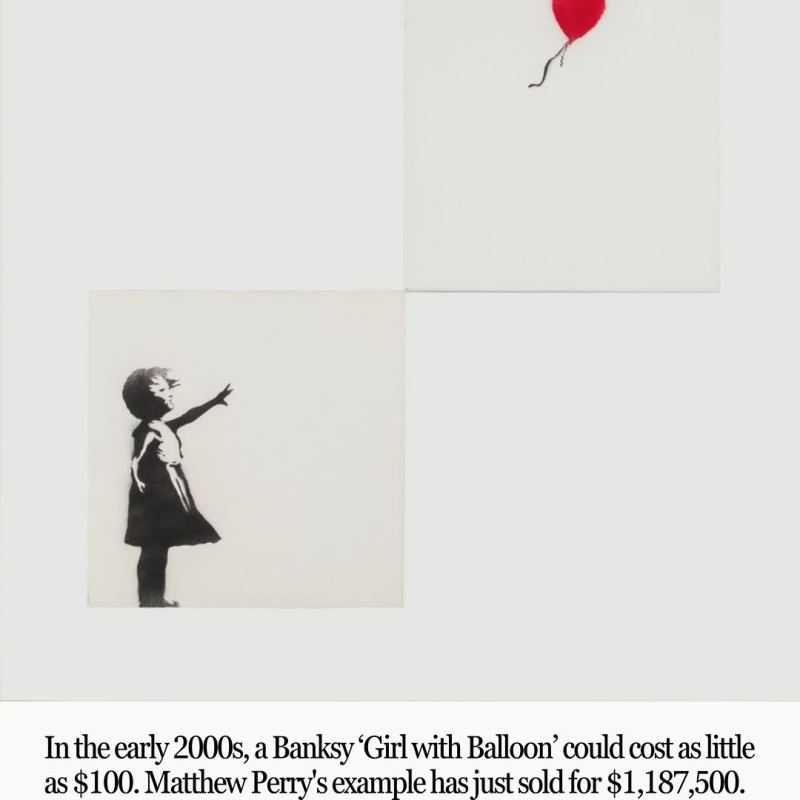
A child reaches for a departing balloon. A masked protester throws flowers instead of a weapon. A maid sweeps dirt behind the surface of a wall. Each image contains characters, conflict and an implied before and after.
Banksy is not simply a satirist who happens to paint outdoors. He is a remarkably economical storyteller. His walls function like single-frame films. The setting is real, the actors are invented and the surrounding city provides the plot.
This is what makes the Lucas Museum such a fitting setting. The institution is deliberately challenging the boundary between fine art and visual forms once dismissed as commercial, popular or disposable. Street art sits alongside murals, cinema, illustration and comics, rather than being treated as an entertaining disruption of supposedly serious art.
Banksy’s practice is perfectly suited to that framework. His images have always depended on circulation. They move from streets to photographs, then into newspapers, social media, prints and public memory. The original wall may disappear, but the image continues to travel.
Like a comic panel or a film still, the work survives because it is seen, shared and retold.

The Maverick’s Route to the Museum
Art history has seen this journey before. Jean-Michel Basquiat began by writing cryptic statements under the name SAMO across Lower Manhattan. He carried the velocity of the street into the studio, combining language, anatomy, race, music and historical violence in paintings that refused to behave politely.
Today, Basquiat’s work is held by institutions including the Museum of Modern Art in New York. The visual language once dismissed as chaotic or raw now occupies the centre of modern art history.
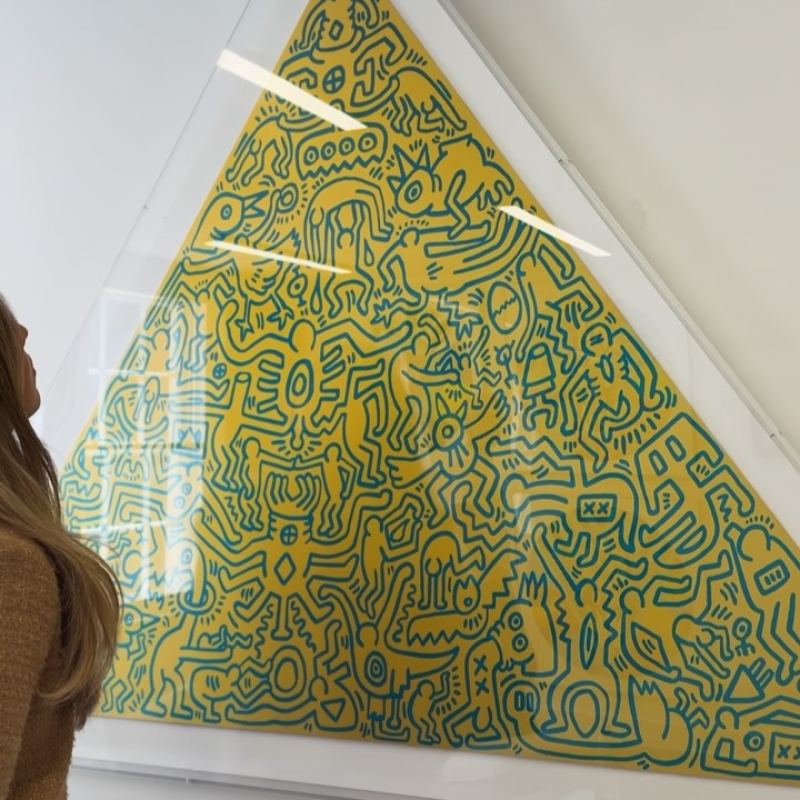
Keith Haring followed a similarly unconventional route. His chalk drawings appeared on empty advertising panels throughout the New York subway system, reaching commuters before collectors. His radiant babies, barking dogs and dancing figures became a public language, immediate enough to engage a passing stranger but sophisticated enough to address sexuality, political oppression and the AIDS crisis.
Haring’s work is now held by the Whitney Museum of American Art and other leading international institutions. The museum did not make his work culturally significant. It eventually recognised the significance that was already there.
David Hockney represents a different kind of maverick. He did not emerge from graffiti culture, but his independence has been just as persistent. Across painting, photography, printmaking, fax machines, photocopiers and digital drawing, Hockney has repeatedly questioned how images construct space, time and perception.
His work now sits at the heart of major collections, including Tate’s, but institutional recognition has never dulled his curiosity. If anything, Hockney demonstrates that entering the canon does not require an artist to stop experimenting.
That distinction is crucial for Banksy.
Basquiat’s paintings did not lose their anger when they entered MoMA. Haring’s figures did not stop dancing when they reached the Whitney. Hockney’s experiments did not become conventional because Tate acquired them.
Museums do not create the importance of these artists. At their best, they preserve, examine and communicate it.
The Problem With Putting a Wall Behind Glass
Banksy nevertheless presents institutions with a particular challenge.
Street art gains much of its meaning from location, timing and vulnerability. It belongs to a specific wall, neighbourhood and political moment. Remove a mural from that environment and something inevitably changes. The physical object may be preserved, but its social context can easily be lost.
Museums must therefore resist presenting Banksy as little more than a producer of valuable and familiar icons. His work belongs to a much larger history of public space. It asks who owns the city, who controls its surfaces, who is allowed to speak and who gets to decide whether an image is art, vandalism or a sudden opportunity for property investment.

The Lucas Museum appears alert to at least part of this challenge. Its presentation places Banksy alongside major muralists and public artists including Diego Rivera, Judith F. Baca and JR. In this context, the wall is treated as a narrative surface rather than an oversized substitute for canvas.
That shift could move the conversation beyond the familiar questions of Banksy’s identity, celebrity and auction prices. It allows institutions and audiences to consider the more interesting question of what his images actually do.
They interrupt. They provoke. They communicate at speed. Most importantly, they tell stories to people who may never have intended to look at art that day.
From Institutional Prank to Institutional Presence
The Lucas Museum may represent a beginning rather than a culmination.
The inclusion of studio-sourced work creates opportunities for serious conservation, scholarship and curatorial interpretation. It may encourage other institutions to examine Banksy not only as a market phenomenon or celebrated prankster, but as an artist whose practice connects graffiti, political cartooning, conceptual art, performance, film and mass communication.
There is, of course, a delicious contradiction in watching one of the world’s most famous anti-establishment artists enter a billion-dollar museum created by the man behind Star Wars. Then again, rebellion has always been central to Lucas’s universe.
Banksy once entered museums by exploiting their confidence in their own authority. Now an institution is preparing to admit him openly and on terms that may finally acknowledge the full narrative ambition of his work.
The rebel has not necessarily joined the establishment.
The establishment has simply begun to realise that the rebel was already part of art history.